
Turn your wrist over under a light and look at your veins. If they appear green, you’re likely warm-toned. If they look blue or purple, you’re likely cool-toned. That’s your first clue.
What Is Undertone?
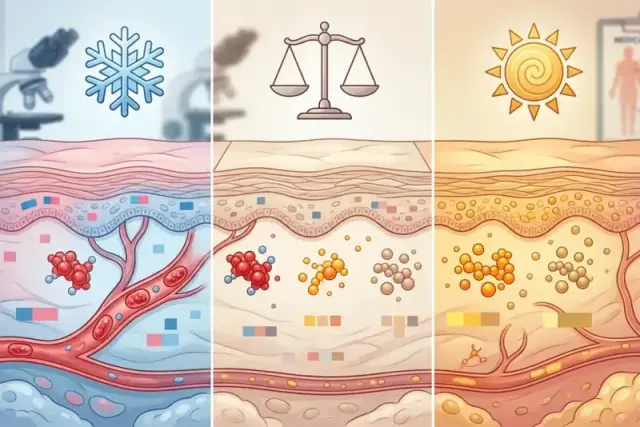
Undertone is the color temperature layered beneath your skin’s surface. Even two people with the same beige complexion can look completely different — one glows golden, the other reads pink-rosy. That difference is undertone.
Two things to remember:
- Undertone is independent of skin brightness — fair skin isn’t always cool; dark skin isn’t always warm
- Undertone is permanent — tanning, seasons, and makeup don’t change it
Common Misconceptions — Cleared Up First
4 Ways to Find Your Undertone
Use multiple tests and go with the majority. If 3 or more point in the same direction, that’s your undertone.
Warm Undertone
A golden, peachy warmth sits beneath the skin. In natural light, the skin takes on a golden or honey-toned quality.
Skin Characteristics
- Skin base: golden, peach, ivory, warm beige
- Sun response: tends to tan to a golden color
- Natural flush: warm peach-apricot toned blush
Visual Self-Check Indicators
For color palettes and makeup application, see the Warm, Cool & Neutral Practical Guide.
Cool Undertone
A pink or lavender-rosy tone sits beneath the skin. The skin reads pink or rosy rather than golden, especially in natural light.
Skin Characteristics
- Skin base: pink, rosy, lavender-tinged, cool beige
- Sun response: tends to burn red rather than tan golden
- Natural flush: cool pink-rose toned blush
Visual Self-Check Indicators
For color palettes and makeup application, see the Warm, Cool & Neutral Practical Guide.
Neutral Undertone
Neither warm nor cool dominates — the skin base reads beige or cream without a clear temperature lean.
Skin Characteristics
- Skin base: beige, cream, soft ivory (no strong temperature bias)
- Sun response: mild — can both burn slightly and tan lightly
- Natural flush: subtle, neutral-toned
Visual Self-Check Indicators
For color palettes and makeup application, see the Warm, Cool & Neutral Practical Guide.
Warm · Cool · Neutral at a Glance
Undertone Self-Diagnosis Checklist
해당하는 항목을 모두 체크해보세요
웜톤·쿨톤 항목에 5개 이상 해당하면 해당 언더톤일 가능성이 높습니다.
Why Undertone Is Trickier in Korean and Asian Skin
The warm/cool boundary tends to be subtler for Koreans than for Western populations. Three reasons:
- The warm/cool gap is smaller — The difference between warm and cool pigment levels is relatively narrow, so the vein test alone often isn’t clear enough. Multiple tests are needed.
- Neutral proportion is high — An estimated 30–40% of Koreans fall in the neutral range.
- Surface yellow cast ≠ warm undertone — Korean skin often shows a surface yellow tint even when the actual undertone is cool. The yellow cast is a surface color; the undertone is underneath it.
For PIH rates, barrier characteristics, and ingredient strategies suited to Korean skin, see the Korean Skin Characteristics Guide.
From Undertone to Personal Color
Once you know your undertone (warm or cool), adding brightness (light vs. deep) and chroma (vivid vs. muted) narrows it down to your 4-season personal color type. This is why someone warm-toned might not suit every coral, or a cool-toned person might look off in lavender — brightness and chroma matter just as much.
→ Personal Color Self-Diagnosis Guide
Home draping, vein & metal tests to identify your 4-season type
→ What Is Personal Color? — The 4-Season System
Spring Warm · Summer Cool · Autumn Warm · Winter Cool color palettes
→ Personal Color Web Diagnosis
Identify your undertone and seasonal type in one step
Frequently Asked Questions
Key Takeaways
- Undertone is the color temperature beneath your skin — Warm (golden·peach), Cool (pink·lavender), Neutral (beige·cream)
- It’s a permanent biological constant — tanning, seasons, and makeup don’t change it
- Warm signals: green veins, gold jewelry, golden tan
- Cool signals: blue-purple veins, silver jewelry, burns red
- Neutral signals: ambiguous vein color, both metals work
- ~30–40% of Koreans are neutral — use 3+ tests, not just one
- Undertone is the primary criterion in personal color — brightness and chroma then subdivide into 4 seasons